
Reflections on Healing, Hope, and World Mental Health Day
When you hear the phrase “mental health,” what comes to mind?
For many, the immediate thought is counseling or therapy.
Counseling can play an important role in healing, and it is something we include in all of our programs at THRIVEGulu. But after years of walking alongside survivors in northern Uganda, we have learned that healing often begins long before someone sits down with a counselor and continues long after they leave.
Sometimes healing begins when a person realizes they are not alone.
Sometimes it begins when someone discovers strengths they didn’t know they had.
Sometimes it begins when a different future starts to feel possible.
For Nyamuch, healing began with learning to see herself differently.
Nyamuch, a South Sudanese refugee and mother of four, arrived in Uganda carrying deep trauma after witnessing the killing of her parents and two brothers. She experienced hopelessness, social withdrawal, insomnia, and recurrent thoughts of death.
Through THRIVEGulu’s Mental Health and Psychosocial Support intervention, including individual counseling and the 12-week Dance+Therapy program, Nyamuch gradually regained hope and confidence. She learned grounding techniques, breathing exercises, positive affirmations, and healthy coping strategies. Her self-statement, “I am strong,” became a source of resilience.
Today, she reports improved wellbeing, stronger social connections, and greater confidence. She now supports peers facing similar challenges.
One way Nyamuch reflected on her journey was through an exercise called the River of Life.
A River of Life
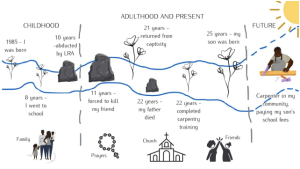
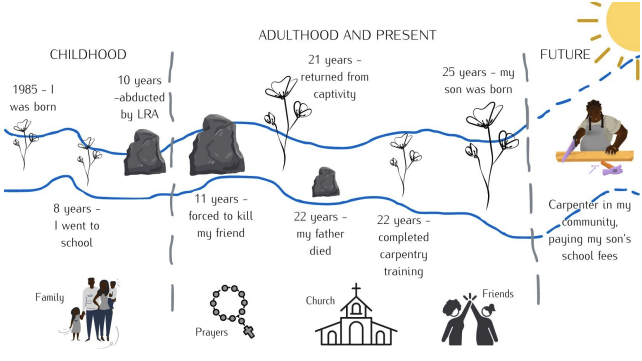
Through THRIVEGulu’s Dance+Therapy curriculum, participants visually map their life experiences through this exercise: the River of Life.
Along the way, they add rocks that represent painful milestones such as loss, trauma, displacement, hardship, or disappointment. They also add flowers to represent positive events: moments of joy, important relationships, accomplishments, and sources of strength.
As participants look back over their rivers, many begin to see their stories differently. The difficult stretches are still there, but so are the people, opportunities, and experiences that carried them forward. They learn to process their experiences and recognize their own strength.
One participant, Grace, a South Sudanese refugee, described her river this way:
“When I made my River of Life, I remembered many painful things that happened to me. I also saw how far I have come and the people who helped me. I learned that even though my past was painful, my life can still have a good future. I now feel stronger and have hope again.”
Another participant, Gloria, reflected:
“When I drew my River of Life, I saw that my journey was not only made up of painful rocks and difficult turns. There were also flowers—moments of strength, support, and hope that helped me keep moving. Dance+Therapy helped me understand that, although I cannot change the difficult parts of my past, I can choose how I move forward. Today, I feel stronger, more confident, and hopeful about my future.”
Every person’s story contains both rocks and flowers. Neither tells the whole story on its own. Together, they help us see a fuller picture of where we have been, what we have survived, and what has helped us keep going.
The River Keeps Moving
Healing is rarely a straight line. Like a river, it twists, widens, narrows, and changes course. Even after periods of turbulence, the river continues forward.
At THRIVEGulu, we see those moments every day: a woman learning to read, a tailor beginning a business, a child discovering the joy of books, or a savings group gathering in support of one another.
On World Mental Health Day, we celebrate not only recovery from trauma, but also the many small and significant milestones that help people move forward.
The River of Life is described in our Dance+Therapy curriculum this way:
“Your river will help you see the big-picture story of your life and help you weave your most difficult moments together with your positive, life-giving moments and allow your river to flow into a more hopeful and meaningful future.”
Healing is not about erasing the difficult parts of our stories. It is about recognizing that those difficult moments are only part of the story.
Healing involves more than processing what has happened in the past. It is also about imagining the possibility of what comes next.
Nyamuch’s story is still being written.
The trauma that brought her and her children to Uganda are part of her story, but it is not the end of it. Like many participants in THRIVEGulu’s programs, she continues to build new chapters for herself and her children.
At THRIVEGulu, we see stories like hers every day.
And like a river, those stories keep moving forward.
We see survivors becoming THRIVERS.